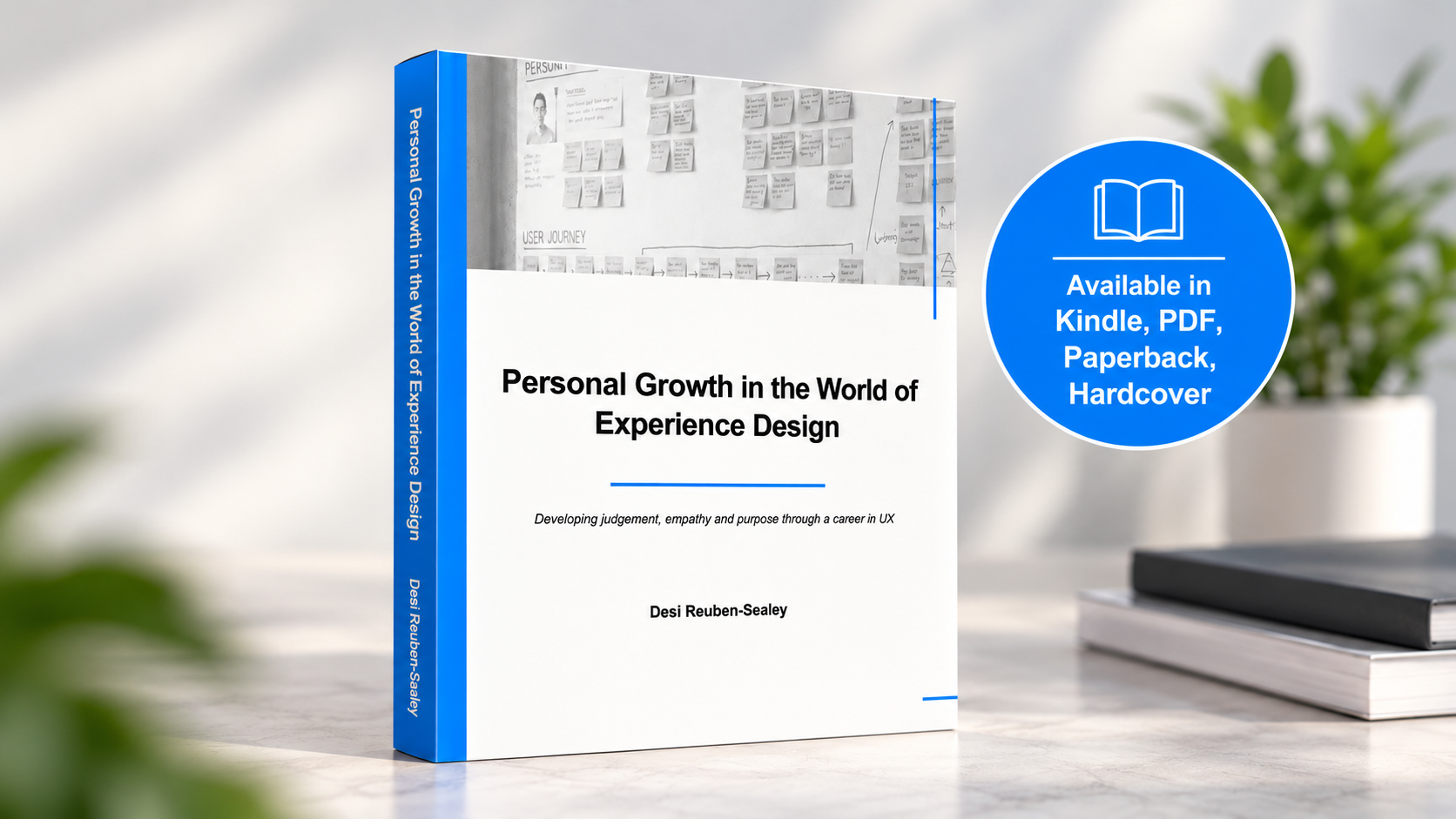
Personal Growth in the World of Experience Design
Developing judgement, empathy and purpose through a career in UX
Author: Desi Reuben-Sealey
I wrote Personal Growth in the World of Experience Design because some of the most important lessons in my UX career have involved reconsidering my own judgement.
Technical knowledge has helped me understand how products and systems work. Experience has also shown me that knowing how to create something does not answer every question about whether we should, whose needs we are considering, or how we respond when someone challenges our thinking.
This book explores that relationship between professional practice and personal development, through experiences that have shaped my own approach.
Why I wrote this book
While working on an early design system for Debenhams, a senior designer proposed expanding the secondary colour palette to give us more flexibility in how we used calls to action.
I was hesitant. There were constraints I believed we needed to respect. But listening to their reasoning revealed latitude I had overlooked.
What stayed with me was not simply the design decision. It was recognising that my understanding of the constraints had been incomplete.
Listening did not require me to abandon professional judgement. It helped me improve it.
That experience belongs in a book about empathy, but also about humility, collaboration and our willingness to change our minds. These qualities influence how we use the technical skills we work hard to develop.
What the book explores
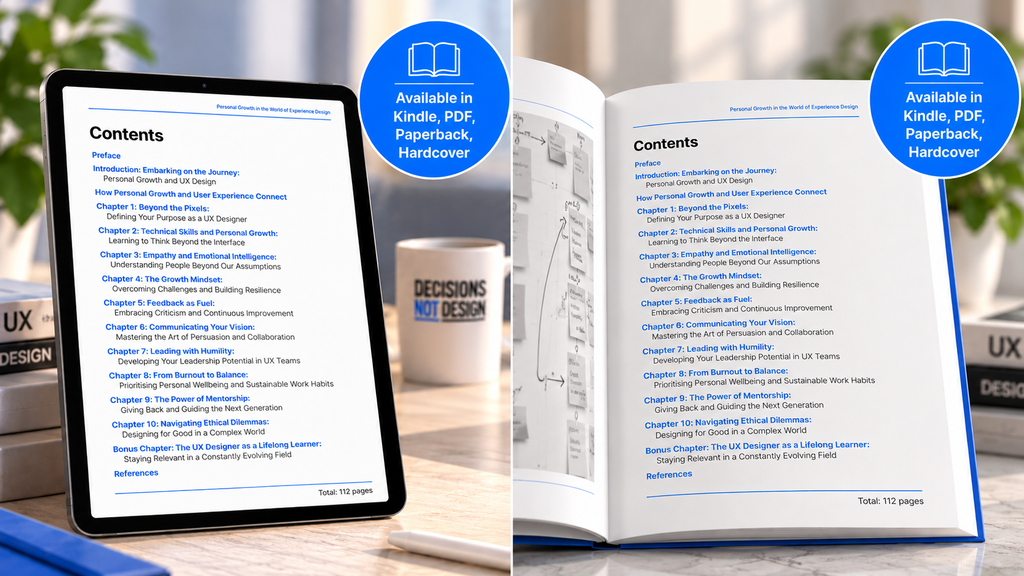
Across ten chapters and a bonus chapter, the book follows the personal development that accompanies a career in UX.
It begins with purpose, technical understanding and emotional intelligence, then explores how we respond to challenges, evaluate feedback and communicate across different responsibilities.
The later chapters consider leadership, wellbeing, mentorship and ethical decisions. The bonus chapter reflects on remaining curious without turning every part of life into another obligation to become more productive.
These subjects connect through a recurring question: how do we become more thoughtful about the decisions we make and the people affected by them?
The book also includes four questions I use when considering feedback: what do we actually know, what problem are we trying to solve, who is affected and how seriously, and what is the most responsible next step?
They are my working questions, not a formula that guarantees the right answer. Their value is in helping us pause before reacting.
Growth does not have to follow our own path
One of the experiences I share concerns supporting a designer who later moved into sustainability and progressed into management.
I found that deeply rewarding. Their development was not limited to becoming more proficient with UX tools. They were building capabilities that could serve their own interests and ambitions.
Their achievements belonged to them. My contribution did not give me ownership of their success or the right to determine their future.
For me, mentorship involves helping someone develop the confidence and judgement to make decisions independently, including decisions I would not make for myself.
Who this book is for
I wrote this for people entering UX, practitioners developing their confidence and judgement, and those taking responsibility for teams or mentoring others.
It is not a software tutorial. Nor does it suggest that resilience or a positive attitude can overcome every organisational problem. Working conditions, leadership and the opportunities available to us matter.
My intention is to offer experiences and questions readers can examine alongside their own, rather than prescribe a single version of professional success.
Choose your reading format
Explore the available Amazon editions, including Kindle and print options, or purchase the PDF directly from my webshop.
The PDF is a digital download. No physical book is included with that purchase. Check the Amazon listing for the current availability of paperback and hardback editions.
The relationship between UX and personal growth is something I have also explored in my earlier writing. This book gives me room to examine it through more of the experiences behind my practice.
I hope it offers something worth reflecting on, both in your work and beyond it.
Stay present. Remain curious.